Industrial AI in manufacturing: What it does, what it requires, and where to start
Published on 24 August, 2026 in AI
Four core capabilities of industrial AI
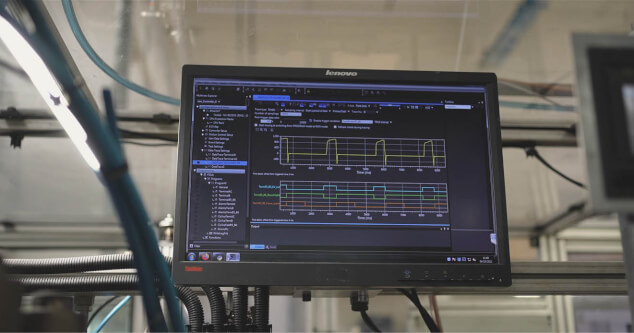
Before AI can do anything useful, it needs eyes and ears on the physical process. Perception in industrial settings means collecting continuous, high-frequency data from the physical world: vibration signals from rotating equipment, thermal images from production lines, current and voltage readings from motors, spectrometer data from chemical processes, video feeds from assembly stations.
2. Prediction — learning from the past to model the future
Prediction models in industrial settings are trained on time-series data: sequences of sensor readings correlated with known outcomes. Given enough historical data, machine learning models identify the subtle patterns that precede a bearing failure, a quality defect, or an energy spike. These signals would be invisible to even an experienced operator watching a single metric
3. Prescription — recommending optimal action
Prediction tells you what is likely to happen. Prescription tells you what to do about it. This third capability moves AI from a monitoring tool to a decision-support system, recommending maintenance windows, process adjustments, or quality interventions before the problem materialises.
4. Autonomy — closing the loop
The fourth capability is the most ambitious: closed-loop control, where the A recommends an action and executes it autonomously, without waiting for a human to confirm. Process parameters adjust in real time based on what the model detects. For most manufacturers, this sits further along the maturity roadmap.
Use cases transforming factories
1. Predictive maintenance
Rather than servicing equipment on a fixed schedule (often too early, occasionally too late) manufacturers use continuous sensor data including vibration, temperature, acoustic emission, and electrical signatures to monitor the actual health of critical assets and intervene only when condition data indicates it is needed. The operational impact is measurable: reduced unplanned downtime, lower maintenance costs, and longer asset life.
2. Vision-based quality inspection
AI-powered machine vision systems now routinely inspect products at production speed. They can detect surface defects, dimensional deviations, and assembly errors that human visual inspection would miss, or that are physically impossible to inspect manually at high line speeds.
3. Energy optimisation
Energy costs are a significant competitive pressure for European manufacturers, particularly since the energy market disruptions of the early 2020s. AI systems that continuously model energy consumption across a facility — correlating it with production schedules, ambient temperature, equipment state, and utility tariff structures — identify optimisation opportunities that would take months to find through conventional analysis.
4. Production and supply chain visibility
AI models trained on historical production data, supplier lead times, and demand signals provide manufacturers with dynamic visibility into bottlenecks and disruption risks before they become crises on the shop floor.
5. Process simulation and digital twins
AI-enabled digital twins model an entire production process in real time, predict how changes to process parameters will affect output quality, and enable engineers to test process improvements virtually before implementing them on the physical line. They reduce both the time and risk involved in process changes.
What industrial AI is not
- Not a replacement for experienced operators. Industrial AI improves human judgement; it does not replace it. The knowledge embedded in a production team, such as the context, the judgement calls, the understanding of how a specific line behaves, remains essential.
- Not a plug-and-play product. Each industrial environment is different. A model built for one facility will not transfer directly to another without adaptation. The data structures, process characteristics, and failure modes are specific, which is why off-the-shelf AI products rarely deliver without significant configuration work.
- Not only for large enterprises. Smaller manufacturers can benefit considerably from targeted applications — predictive maintenance on critical assets or vision inspection on high-value lines — where the return is concrete and the scope is manageable.
- Not flawless. A model trained on three years of normal operation will perform poorly when it encounters a failure mode it has never seen. Model performance needs to be monitored, updated, and validated as conditions change.
The European context
- Regulation. The EU AI Act, with full high-risk obligations active from August 2026, and the EU Data Act, applying to IoT and connected-product data from September 2026, create a mandatory governance framework covering how industrial AI systems are deployed and how the data they generate is handled.
- Data sovereignty. European manufacturers, particularly in automotive, chemicals, and defence supply chains, handle sensitive production data that cannot leave the EU. Cloud and edge architectures need to be designed with geographic compliance in mind from the outset.
- Sustainability obligations. The EU Green Deal, Corporate Sustainability Reporting Directive (CSRD), and Carbon Border Adjustment Mechanism create real financial and reputational pressure to reduce energy intensity and emissions. These make AI-driven energy optimisation both a cost play and a compliance requirement.
- Competitive pressure. Structural cost competition from Asian manufacturers means European producers need to find productivity and quality gains from existing assets. AI-enabled improvements on existing lines, without the capital cost of new equipment, represent a direct response to that pressure.
Three questions to ask before investing
2. Are the systems connected? The more powerful applications such as cross-line analytics, plant-wide energy optimisation, supply chain visibility, require data to move reliably between the field layer, the edge, and enterprise systems. Many manufacturers discover during an AI project that their IT and OT infrastructure was not designed with that kind of data flow in mind.
3. What is the highest-value problem you can define precisely? AI tools perform best when the problem is specific and measurable. "Improve our overall quality" is not a problem definition a model can work with. "Reduce the rate of dimensional defects on line 2 during shift changeovers, which currently account for 22% of rework" is. The precision of the problem statement is directly proportional to the likelihood of a useful result.
Discover how to get started and read more on OMRON’s i-BELT Service